I. Historical Evolution of Sheet Metal Processing: From Manual Craftsmanship to Mechanical Innovation
The origin of sheet metal processing can be traced back to ancient civilizations thousands of years ago. Its development can be roughly divided into three core stages. Each stage is accompanied by technological breakthroughs and demand upgrades, gradually moving from "craftsmanship-driven" to "equipment-driven" and from "extensive processing" to "precision manufacturing."
(I) Manual Era: Primitive Form Dominated by Craftsmanship (Ancient Times - Before the Industrial Revolution in the 18th Century)
The embryonic form of sheet metal processing can be traced back to 4,000 to 5,000 BC, when humans had mastered simple metal processing skills. Due to the low level of productivity, sheet metal processing at this time relied entirely on manual operations. The core materials were naturally malleable metals such as gold and silver. The ancients repeatedly forged metal blanks into thin sheets with stone or metal hammers, and then made them into jewelry, utensils, armor, and other items through simple bending and splicing. There were no standardized tools for processing at this stage; it all depended on the craftsman's experience and skills. The processing efficiency was extremely low, the finished products had poor precision and consistency, and only a small number of simple-shaped components could be processed.
With the progress of civilization, humans gradually mastered the smelting technologies of copper, bronze, iron, and other metals, and the range of materials for sheet metal processing continued to expand. In the Middle Ages, blacksmiths began to use simple hand tools such as chisels, anvils, and hand shears to cut and bend thin metal sheets for making practical items such as farm tools, weapons, and architectural decorations. It is worth mentioning that in 1480, Leonardo da Vinci first depicted the prototype of a "double-cylinder roller mill" in his design drawings, proposing the idea of processing sheets by extruding materials through two parallel-axis rollers, laying an early foundation for the mechanization of subsequent sheet metal processing. At this stage, sheet metal processing was always an "extension of manual craftsmanship," did not form large-scale production, and its core value was to meet people's basic production and living needs.
(II) Mechanical Era: Mass Upgrade Empowered by Equipment (18th Century Industrial Revolution - Mid-20th Century)
The outbreak of the Industrial Revolution in the 18th century brought the first fundamental change to sheet metal processing - mechanical equipment gradually replaced manual operations, promoting sheet metal processing from "individual craftsmanship" to "large-scale production." The core breakthrough of this stage was the invention and application of special processing equipment, which solved the pain points of low efficiency and poor precision of manual processing.
In the early stage of the Industrial Revolution, with the popularization of power equipment such as steam engines and internal combustion engines, various sheet metal processing machinery emerged one after another: in the mid-19th century, punch presses and die presses came into being. They realized mass stamping and forming of thin metal sheets through mechanical force, which could quickly produce uniform specifications of holes, grooves, and other structures, greatly improving production efficiency and promoting sheet metal processing into the "mass production era." At the same time, manual shears and bending machines were gradually upgraded to mechanical drive, the cutting precision and bending consistency were significantly improved, and thicker and wider metal sheets could be processed. The large-scale application of rolling mills became an important turning point in sheet metal production, realizing the standardized rolling of thin metal sheets, providing raw materials with uniform specifications for subsequent processing, and completely changing the extensive mode of traditional manual rolling.
At this stage, the application scenarios of sheet metal processing gradually expanded from traditional farm tools and utensils to emerging fields such as automobile, ship, and machinery manufacturing. For example, the body shells of early automobiles and the deck components of ships were all mass-produced through mechanical sheet metal processing, and sheet metal processing gradually became a basic supporting process in the manufacturing industry. However, the equipment at this time still required manual operation, the degree of automation was low, the processing precision still had room for improvement, and it was difficult to process complex-shaped sheet metal components.
(III) Automation Era: Precision Leap Led by Numerical Control (Mid-20th Century to Present)
In the mid-20th century, the birth and popularization of numerical control technology brought the second revolutionary breakthrough to sheet metal processing, promoting it into the initial stage of "precision, automation, and intelligence." The core feature of this stage is that "numerical control equipment dominates the entire processing process." Through computer programs to control the operation of equipment, it completely solves the error problem of manual operation in the mechanical era and realizes the processing needs of high precision, high efficiency, and high consistency.
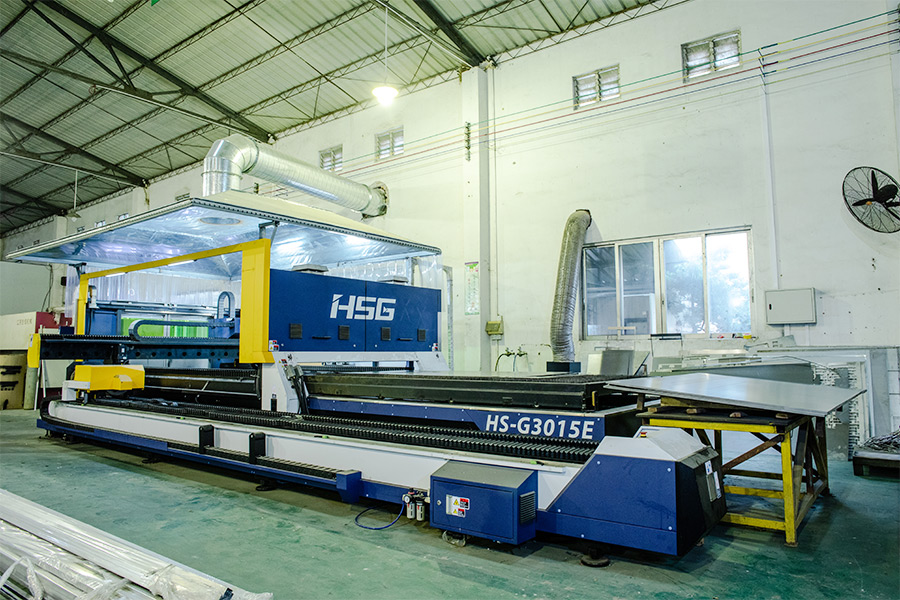
In the late 20th century, CNC (Computer Numerical Control) shears, CNC bending machines, and CNC punch presses were put into use one after another. Operators only need to set processing parameters through programming, and the equipment can automatically complete a series of operations such as cutting, bending, and stamping. The processing precision is improved from millimeters to microns, which can handle complex sheet metal structures, and greatly reduces labor costs and scrap rates. In the 21st century, laser cutting technology has gradually replaced traditional cutting processes. It has the advantages of fast cutting speed, high precision, no burrs, and wide material applicability. It can cut various metal sheets such as stainless steel, aluminum alloy, and titanium alloy, and even realize precise cutting of complex patterns, further expanding the application boundary of sheet metal processing.
In recent years, the in-depth integration of industrial robots and sheet metal processing equipment has promoted automated processing into a new stage. For example, the sheet metal "one-piece flow" production mode launched by enterprises such as KUKA integrates laser cutting, sorting, stamping, bending, assembly, and other whole-process processes through robots, realizing seamless connection from raw materials to finished products. Robots achieve precise positioning (precision up to ±0.1mm) through visual systems, complete automatic loading and unloading, sorting, bending, and other operations, supporting 24-hour uninterrupted production, greatly improving production efficiency and product consistency, and reducing labor dependence. At this stage, sheet metal processing has formed a mainstream mode of "numerical control + automation," and its application scenarios cover many high-end fields such as aerospace, electronic appliances, new energy, and high-end equipment, becoming one of the indispensable core processes in modern manufacturing.
II. Future Trends of Sheet Metal Processing: Intelligence, Greenization, and Flexibility Lead Industry Upgrading
With the continuous progress of science and technology, and the promotion of national strategies such as the "dual carbon" goal and the upgrading of high-end manufacturing industry, the sheet metal processing industry is ushering in a new round of changes. In the future, sheet metal processing will develop in the direction of "intelligence, digitalization, greenization, and flexibility," gradually realizing "whole-process intelligent management and control, whole-chain green and low-carbon, and all-round flexible adaptation," further improving processing efficiency, reducing costs, and expanding application boundaries.
(I) In-depth Upgrade of Intelligence: Unmanned Production Becomes the Norm
In the future, the intelligence of sheet metal processing will no longer be limited to the automation of a single device, but will realize "whole-process intelligent management and control," and unmanned factories will become the mainstream of the industry. On the one hand, the integration of industrial robots and sheet metal processing equipment will be more in-depth. Robots will have stronger independent decision-making capabilities. Through visual recognition and artificial intelligence algorithms, they can automatically adapt to changes in material thickness and specifications, adjust processing parameters, and complete the whole-process operations such as processing, assembly, and inspection of complex components without manual intervention. For example, robots can automatically identify defects in sheet metal components, feed back and adjust processing processes in real time, and greatly improve product qualification rates.
On the other hand, the Internet of Things (IoT) technology will be fully applied in sheet metal processing workshops to realize the interconnection of equipment, materials, and personnel. Through sensors to collect real-time operation data of processing equipment, material consumption data, and product processing data, and then through big data analysis, it can realize equipment fault early warning, production progress control, and accurate material scheduling, optimize the production process, and improve production efficiency. In addition, artificial intelligence algorithms will be applied to the optimization of processing parameters. By learning a large amount of processing data, the optimal processing plan can be automatically generated, reducing the impact of manual experience on processing quality, and realizing "precision processing and efficient production."
(II) Full-chain Digital Connection: Seamless Connection Between Design and Production
Digitalization will become the core competitiveness of the sheet metal processing industry. In the future, it will realize full-chain digital connection from design, processing to inspection and after-sales service. In the design stage, CAD/CAM software will be deeply integrated with 3D modeling and simulation technology. Designers can complete the design of sheet metal components through 3D modeling, and then simulate the processing process through simulation technology to predict possible deformation, defects, and other problems in the processing process in advance, optimize the design plan, and reduce trial and error costs.
In the processing stage, design data will be directly imported into numerical control equipment to realize seamless connection between "design and processing" without manual secondary programming, which greatly improves processing efficiency and ensures the consistency between processing precision and design plan. The application of 3D printing technology will further improve the digital processing system. Making sheet metal processing molds through 3D printing can shorten the turnover time from several weeks to 1-2 days, greatly reducing the mold cost of small-batch production, especially suitable for prototype manufacturing and small-batch customized production. In the inspection stage, automatic inspection equipment will replace manual inspection. Through machine vision, laser inspection, and other technologies, it can quickly complete the size, precision, and defect inspection of sheet metal components. The inspection data will be uploaded to the digital platform in real time to realize the full traceability of product quality.
(III) Prominent Green Development: Low-Carbon Environmental Protection Runs Through the Whole Process
With the advancement of the "dual carbon" goal and the increasing stringency of environmental protection regulations, green and low-carbon will become the consensus of the sheet metal processing industry. In the future, "greenization of the whole processing process" will be realized. In terms of material selection, priority will be given to environmentally friendly, recyclable, and lightweight metal materials, such as aluminum alloy, magnesium alloy, and recycled steel. These materials can not only reduce the weight of products but also reduce resource consumption and environmental pollution. For example, the battery tray of new energy vehicles uses aluminum alloy materials, which can reduce the weight by 40% and can be 100% recycled.
In terms of processing technology, high-energy-consuming and high-pollution processing methods will be gradually eliminated, and green processing technologies such as laser cutting and plasma cutting will be promoted. Compared with traditional plasma cutting, laser cutting saves more than 40% energy, the electro-optical conversion efficiency of fiber lasers reaches 50% (traditional YAG lasers only 3%), and there is no mold loss, metal dust can be collected, reducing waste generation and environmental pollution. At the same time, by optimizing the processing path and improving material utilization, the waste of leftover materials is reduced. For example, using a visual recognition system to mark the size of leftover materials can increase the secondary utilization rate of leftover materials to more than 85% (less than 50% in traditional methods). In addition, the waste water, waste gas, and waste residue generated in the processing process will be effectively treated to achieve "zero pollution and low emission." Some enterprises will explore the "green power coupling" mode, connecting clean energy such as photovoltaic power to processing equipment to achieve zero carbon emissions in the processing link.
(IV) Popularization of Flexible Production: Adapting to Customized and Small-Batch Needs
With the diversification of market demand, sheet metal processing will gradually bid farewell to the single mode of "large-scale mass production" and move towards "flexible production," which can quickly adapt to the needs of customized and small-batch production. On the one hand, flexible production lines will become the mainstream of the industry. A production line can process sheet metal components of different specifications and shapes by quickly adjusting equipment parameters and replacing molds without re-establishing the production line, greatly shortening the production cycle and reducing production costs. For example, KUKA's flexible production line can realize the rapid switching of more than 20 types of sheet metal parts through the robot's automatic quick-change gripper, and the mold change time is shortened to less than 3 minutes.
On the other hand, small-batch and customized processing will become a new growth point of the industry. With the development of fields such as aerospace, high-end equipment, and new energy, the demand for customized sheet metal components will continue to increase. Sheet metal processing enterprises will realize efficient and precise processing of small-batch customized products through digital design, 3D printing molds, flexible production lines, and other technologies to meet the personalized needs of different customers. At the same time, flexible production will be deeply integrated with the supply chain to realize "on-demand production and precise supply," reducing inventory backlogs and improving the flexibility and efficiency of the supply chain.
III. Conclusion
From manual forging in ancient times to mechanical innovation after the Industrial Revolution, and then to today's automated and numerical control production, every step of the development of sheet metal processing is inseparable from technological breakthroughs and the promotion of market demand. For thousands of years, it has developed from a simple manual craft to a core process supporting modern manufacturing, witnessing the progress of human industrial civilization.
Looking forward to the future, under the development trends of intelligence, digitalization, greenization, and flexibility, the sheet metal processing industry will usher in new development opportunities and challenges. Intelligence will realize unmanned production and improve efficiency and precision; digitalization will break down the barriers of the whole chain and reduce costs and trial and error risks; greenization will practice the concept of low carbon and realize sustainable development; flexibility will adapt to diverse needs and expand the industry boundary. It is believed that driven by technological innovation, sheet metal processing will continue to break through its own limitations, play a more important role in the upgrading of high-end manufacturing industry and the realization of the "dual carbon" goal, and continue to bring more convenience and surprises to our production and life.