In the field of sheet metal processing, bending is a core process for shaping metal forms, and its precision directly determines the assembly quality and service life of products. What seems like a simple "angle folding" operation involves the coordination of multiple factors such as material properties, mold design, and equipment parameters. This article systematically breaks down 21 core parameters of sheet metal bending, from the underlying logic of springback compensation to the practical standards for mold selection, helping you unlock the precise control code of the bending process.
I. Basic Material Parameters: The "Inherent Conditions" for Bending
1. Material Grade and Tensile Strength: This is the core premise for setting bending parameters. Low-carbon steel (e.g., Q235) has low tensile strength and excellent bending performance; stainless steel (e.g., 304) has high tensile strength and toughness, requiring greater bending force and being prone to springback; aluminum alloy (e.g., 6061) has moderate hardness but is susceptible to cracking, so the bending radius and speed need to be controlled. Tensile strength directly affects bending force calculation and springback compensation coefficient.
2. Material Thickness (t): Thickness deviation can lead to significant changes in bending force and springback. In actual production, the measured thickness should be used instead of the theoretical value—for example, a 1.0mm cold-rolled sheet may have a measured thickness of 0.95mm. Using the theoretical value to set parameters can easily result in angle deviations. The greater the thickness, the higher the required bending force, and the minimum bending radius also needs to be increased accordingly.
3. Material Yield Strength (σs): The higher the yield strength, the stronger the material's resistance to plastic deformation, and the more obvious the springback phenomenon. For example, high-strength steel has a yield strength of over 590MPa, and its springback is 2-3 times that of ordinary low-carbon steel, requiring targeted adjustment of the compensation angle.
4. Material Elongation: Elongation reflects the material's plastic deformation capacity. Materials with elongation ≥15% (e.g., mild steel) are not prone to cracking during bending and can adopt a smaller bending radius; materials with low elongation (e.g., some high-strength aluminum alloys) require an increased bending radius to avoid cracks.
II. Bending Geometric Parameters: The Core of Defining Product Form
1. Bending Angle (α): Refers to the angle between two planes after bending, divided into internal angle (commonly used) and external angle. The actual setting needs to include the springback compensation amount. For example, if a 90° bend is required and the material springs back by 2°, the mold setting angle should be 88°.
2. Minimum Bending Radius (Rmin): Refers to the minimum arc radius allowed on the inner side of the bend, directly affecting whether the material cracks. Rmin is usually related to material thickness—for example, Rmin≈0.5t for low-carbon steel, Rmin≈1.5t for stainless steel, and Rmin≈1.0t for aluminum alloy (specific values should refer to material manuals).
3. Bending Height (H): Refers to the effective height of the bent edge, which must meet the mold clamping requirements. Generally, H≥2t+R (t is material thickness, R is bending radius). If H is too small, it will cause deformation of the bent edge and unstable angles.
4. Hole Edge Distance (L): Refers to the distance from the bending line to the adjacent hole. To avoid hole deformation or cracking during bending, L≥t+R+0.5mm must be ensured (take a larger value for hard materials and a smaller value for soft materials). If the hole edge distance is insufficient, a process groove should be punched near the hole in advance.
III. Process Control Parameters: The Key to Determining Bending Precision
1. Springback Compensation Amount (Δα): Refers to the angle deviation caused by the elastic recovery of the material after bending, which needs to be offset by reversely adjusting the mold angle. Δα is related to material properties, bending radius, and thickness, and can be determined through test bending: Δα=Mold setting angle - Actual forming angle (a positive value is the springback amount to be compensated).
2. Bending Force (F): Refers to the pressure required for bending, calculated by the formula F=K×σs×t²×L/V (K is the safety factor, 1.3-1.5; σs is yield strength; t is thickness; L is bending length; V is lower mold opening width). The bending force must match the bending machine tonnage—excessive force can damage the mold, while insufficient force cannot achieve forming.
3. Lower Mold Opening Width (V): The width of the lower mold groove, usually V=6-12t (take a smaller value for soft materials and a larger value for hard materials). Too small V will increase material stress, leading to cracking or increased springback; too large V will reduce bending precision and cause "corner collapse".
4. Bending Speed (v): Refers to the downward speed of the bending machine slider, which needs to be adjusted according to material properties. Soft materials (e.g., low-carbon steel) can use a faster speed (5-10mm/s), while hard materials (e.g., stainless steel, high-strength steel) require a reduced speed (2-5mm/s) to avoid material cracking due to excessive instantaneous stress.
5. Dwell Time (t0): The time the slider maintains pressure after bending forming, generally 0.5-3s. Dwell time can reduce springback, especially for thick plates, hard materials, or high-precision bending parts. Insufficient dwell time will increase springback.
IV. Mold-Related Parameters: Core Tools for Adapting to the Process
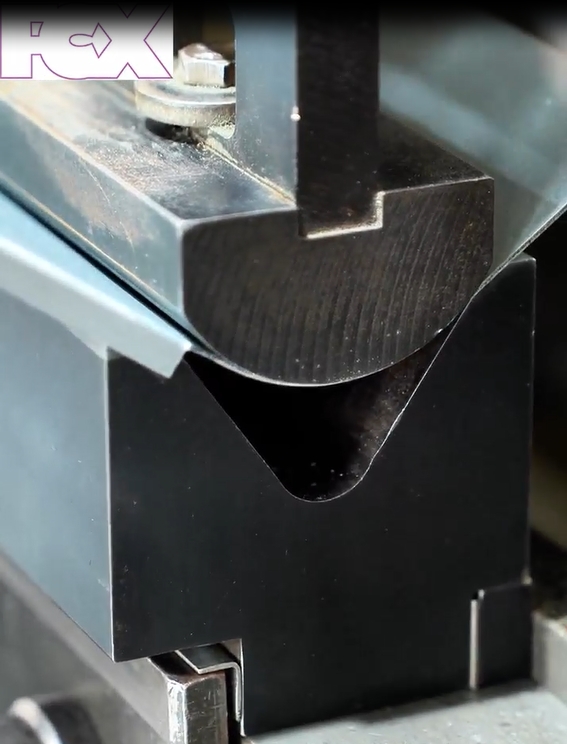
1. Upper Mold Type and Fillet (Rupper): Upper molds are divided into sharp blade molds (Rupper≈0.2-0.5mm), arc molds (Rupper=Rmin+t), etc. Sharp blade molds are suitable for small-radius bending, while arc molds are suitable for large-radius bending or avoiding material indentation. The upper mold fillet must match the bending radius—too large a fillet can cause material sliding, while too small a fillet can indent the material surface.
2. Lower Mold Groove Shape: Common shapes include V-shaped grooves, U-shaped grooves, and rectangular grooves. V-shaped grooves are suitable for ordinary angle bending, U-shaped grooves for large-radius bending or arc forming, and rectangular grooves for continuous bending of multiple edges. The groove angle is usually 85°-90°, which cooperates with the upper mold angle to achieve forming.
3. Mold Clearance (C): Refers to the gap between the upper and lower molds, generally C=t+0.1-0.2mm (take a smaller value for soft materials and a larger value for hard materials). Too small a clearance will indent the material and increase bending force; too large a clearance will lead to excessive bending angles and severe springback.
4. Mold Surface Roughness (Ra): The smoothness of the mold working surface, with Ra≤0.8μm being optimal. Excessive roughness can cause scratches on the material surface—especially for materials with high surface requirements such as stainless steel and aluminum alloy, the mold needs to be polished.
V. Special Scene Parameters: Key Points for Handling Complex Bending
1. Multi-Edge Bending Sequence (S): For complex bending parts, the bending sequence must be reasonably planned, following the principles of "inner first, outer later; small first, large later; simple first, complex later". For example, for box-type parts, internal small edges should be bent first, then external large edges, to avoid interference in subsequent bending.
2. Hot Bending Temperature (T): For thick plates (t≥10mm) or high-hardness materials, hot bending technology is required. The temperature should be controlled below the material's recrystallization temperature (e.g., T=600-800℃ for low-carbon steel, T=800-1000℃ for stainless steel). Excessively high temperature will change material properties, while excessively low temperature cannot reduce springback.
3. Indentation Prevention Parameters: For materials with high surface requirements (e.g., mirror stainless steel, aluminum plates), a protective film should be attached to the mold surface or polyurethane molds should be used. At the same time, the bending force should be controlled to avoid surface indentation caused by excessive pressure.
4. Bending Datum Plane (D): Refers to the positioning datum during bending. A flat surface or key hole of the part should be selected as the datum to ensure that the cumulative dimensional error of multi-edge bending parts is within the allowable range. The datum plane must fit closely with the mold positioning block to avoid positioning deviation.
Conclusion